
The Man Who Misplaced Himself in Ledger Row
No one ever warned Harlan about losing himself on the job—not figuratively, but literally. Yet here he stood at the threshold of the Vault, cravat askew and suitcase in hand, ready to hunt down the identity he’d misplaced somewhere between payroll audits and lunch breaks.
In Ledger Row, where steam-driven abacuses clattered like caffeinated teeth and human resource managers wore hats taller than their sense of irony, the Memory Department’s vaults hummed with more secrets than a banker’s confessional. Each memory, filed in brass canisters and indexed by year, was guarded by thick steel doors and a bureaucracy so dense you could spread it on toast.
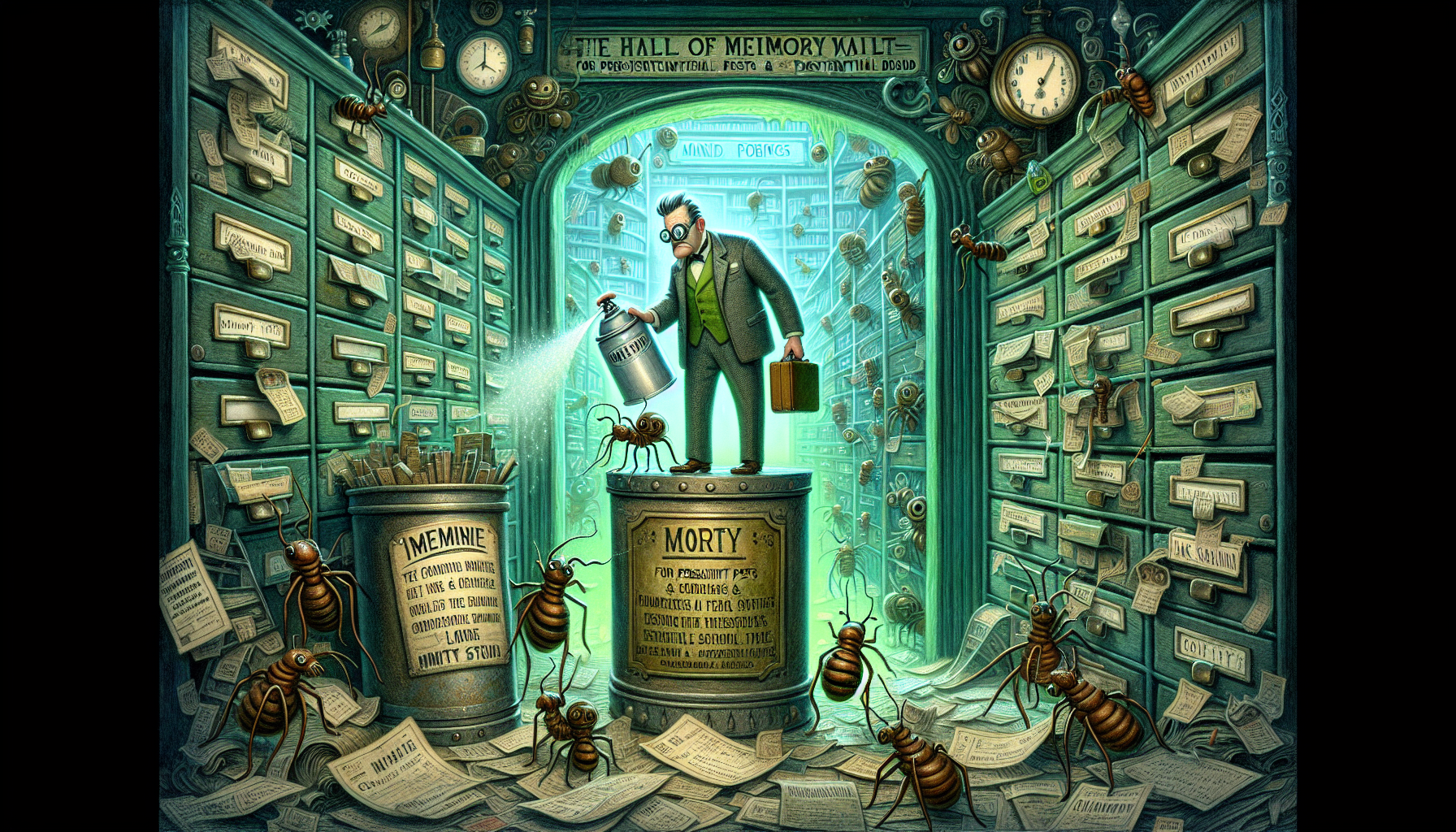
“Are you certain you left your self in there?” asked Vera, his long-suffering coworker. She peered over her spectacles with the patience of someone who’d watched a thousand men misplace their identities among ledgers and half-eaten sandwiches.
“I remember being me before Tuesday,” Harlan said. “After Tuesday? Nothing but fog and pension forms.”
Vera produced a battered silver canister from her carpetbag. “Take this,” she said. “You’ll need it.”
Harlan examined the object: a sturdy spray bottle labeled ‘Mighty Mint—For Persistent Pests & Existential Dread.’
“Extra-strong,” Vera added. “You never know what’s nesting behind those cabinets.”
He nodded—no one wanted to recall last year’s audit, when the spiders formed a union—and pushed open the heavy vault door.
The first corridor was airless and dark, lined with shelves groaning under memories both mundane (tea receipts) and profound (first heartbreaks). Within moments, Harlan heard it: the scritch-scratch of tiny legs plotting insurrection.
From behind a stack of ‘1893: Petty Cash Disbursements,’ a glistening line of ants emerged. They marched in formation around his boots, wielding what looked suspiciously like miniature pay stubs.
Harlan fumbled with the spray, recalling Vera’s warning about safety around pets—and colleagues with delicate sensibilities. A quick squeeze sent out a fine peppermint mist that danced over the ants. The effect was immediate: they recoiled in aromatic horror and retreated beneath the filing cabinet, their grievances unscented.
Crisis one: resolved. Harlan wiped his brow with relief and continued deeper into the archive. He passed rows of rusted timeclocks until reaching the Hall of Reprimands—a chamber infamous for its infestation of roaches addicted to discarded coffee coupons.
Here he paused for fortification: one spritz for each shoe. The minty vapor hung in the air like a promise—or maybe an apology—for every chemical-laden cleaner that had ever been deployed before. Harlan’s shoes now carried an aura that would send even the boldest cockroach scurrying for union-mandated leave.
But as he neared the section labeled ‘Personal Records: H – K,’ the minty freshness gave way to a subtle anxiety. What if he didn’t recognize his own file? What if he opened it to find nothing but blank sheets—a life audited away by routine?
He shook off these thoughts as Vera’s voice crackled through his communicator: “Careful near section twelve! The spiders there have been reading philosophy again.”
Sure enough, he spotted webs stretched between stacks of forgotten holiday requests—each strand vibrating with existential tension. At the center perched a spider of considerable size, eight eyes fixed on him with Kafkaesque resignation.
“State your purpose,” it intoned.
“I’ve come for my identity,” Harlan replied, refusing to meet its gaze for fear of spiraling into a web-based crisis.
The spider advanced—slowly but inexorably—until Harlan, remembering protocol, unleashed another burst of Mighty Mint. The creature recoiled in offense (“What is truth if not a persistent aroma?”), sulked back into its lair, and left him free to claim his prize.
There it was: ‘HARLAN JONES (EMPLOYEE #1127),’ etched in fading ink on an aging folder. He thumbed through old performance reviews (“Met expectations”), faded photographs (“Who is this man?”), and finally found his sense of self—creased but intact—tucked beside an IOU for three vacation days.
With identity reclaimed and nerves still tingling from peppermint vigilance, Harlan retraced his steps to daylight—dodging bitter ants at war with management, side-stepping roaches organizing labor strikes, all buoyed by that lingering scent that reminded him he was safe from both bugs and bureaucracy.
At last he emerged onto Ledger Row again; Vera awaited him beside her bicycle cart. She sniffed appreciatively as he approached.
“Smells like victory,” she said.
“Or at least not defeat,” Harlan replied. He handed back her trusty spray with gratitude; after all, some things—even in an age of industry—should remain natural.
As they cycled away from memory’s labyrinth together—past soot-stained windows and ledger clerks arguing about tea—they laughed at how easy it was to lose oneself in records…and how hard it was to find oneself again without help from friends or a good bottle of minty resolve.
🛍 Product Featured in This Story

Mighty Mint Peppermint Oil Insect Repellent Spray – Natural Indoor & Outdoor Bug Control for Spiders, Ants, Roaches, and More – Plant-Based, Extra-Strong Formula - 16 oz
$19.98 ($1.25 / Fl Oz)
View on AmazonWe may earn a small commission if you purchase through our link.